Meet the 2026 PMFA Award Winner
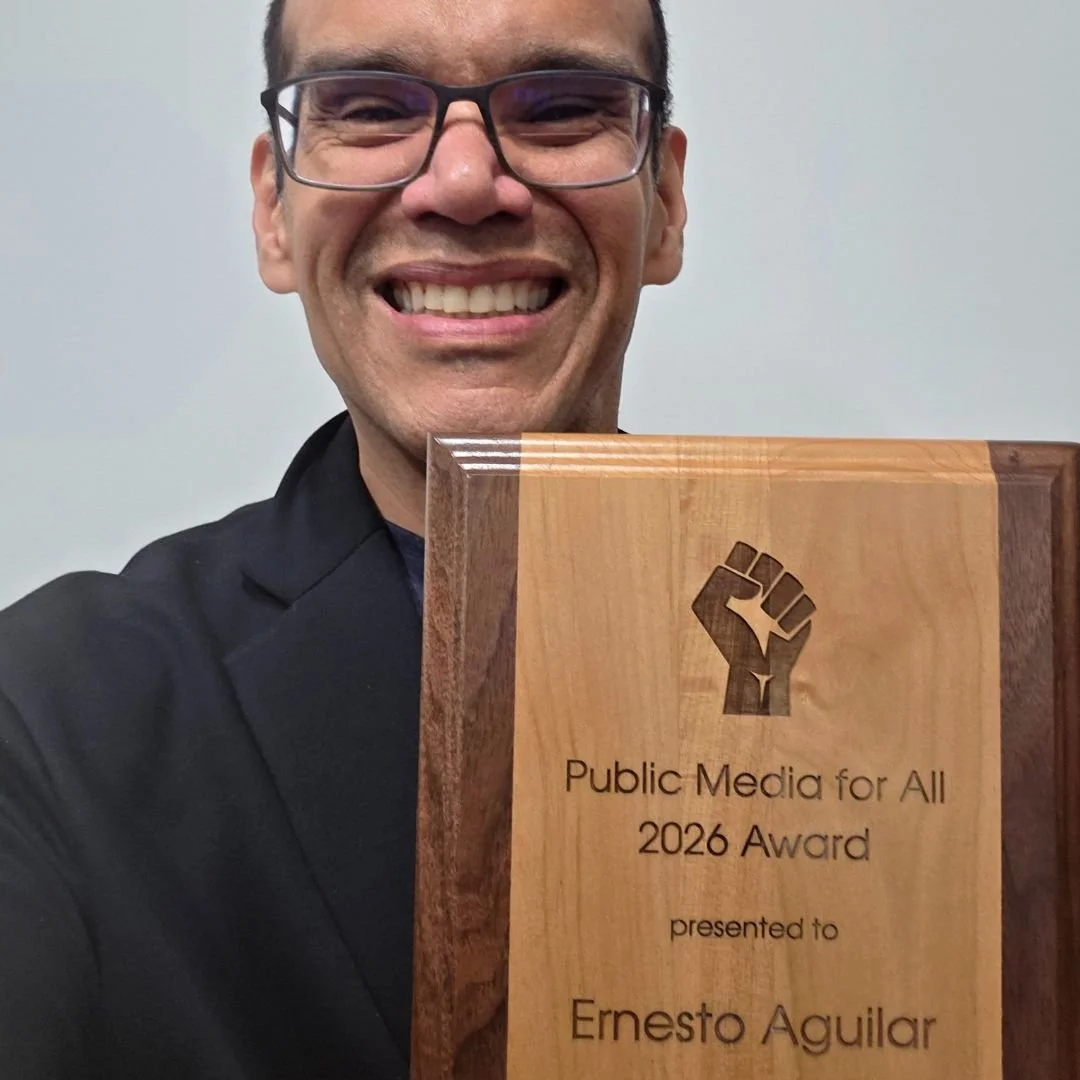
Ernesto Aguilar
Executive Director of Radio Programming and Content Innovation Initiatives, KQED
How did you get started, and what led you to focus on expanding public media for be for everyone?
I have told this story many times—most notably back in 2017 in Current—but my life was fundamentally changed by public media. It was the spark that led me to my high school and college papers and eventually to the Houston Chronicle.
I know, on a very personal level, how public media organizations serve as a proverbial porch light for young people searching for a way forward. To those of us inside the building, a moment on the microphone can sometimes feel like just another part of the job. But for the person listening, that host isn't just an analyst. That person is an ambassador of new ideas. That single broadcast can be the exact transformative moment someone needs at that specific hour of the day or night. It certainly was for me.
I did not just join journalism or public media for a career. I joined out of a deep sense of obligation to pay forward the investment public media made in me. I know well that knowledge is power and opportunity. Public media brings that gift into people’s homes, cars, phones and feeds every day and every night. We only have a limited amount of time in this life. If I’m going to devote mine to anything, I want it to be the betterment of the communities and people around me. That’s the energy I bring to my work: an aspiration to keep that door open so others can find their way in, like I did.
As a professional in public media, how have your personal experiences shaped the way you approach your work?
Growing up in East Houston, you learn early that your environment is a masterclass in human nature. Denver Harbor is a barrio of blacktop streets, drainage ditches and endless chain-link fences. It is also a place where you live in close quarters with working people with countless experiences. To thrive there, you have to navigate a range of attitudes and situations with wisdom. You learn how to fit in and negotiate life while still finding the courage to assert who you are.
That upbringing was humbling, but it was also my greatest training ground. It taught me that none of us knows everything, and that being resourceful, a sharp listener and deeply attuned to the people around you are the most valuable tools you can possess.
I carry those lessons into every room I enter now. I’ve also learned to appreciate every moment I have, because I’m painfully aware of how many people I grew up with didn't get the same chances.
When I mentor emerging leaders in public media, I’m not speaking from theory, even now. I sympathize with their concerns because I’ve lived them. I know what it feels like to be doubted in this industry, and I know the weight of being the only person who looks like me in the room. I wasn't a backseat baby, and I didn't come from a prestigious college. Like I did when I was growing up, I have had to trust my own instincts and remain firm in the belief that my perspective is not just valid, but essential.
Can you share some of the key actions or initiatives you’ve led that have really made an impact over the years?
I have always believed it isn’t for me to quantify my own impact. That is a verdict only the community can deliver. But when I look back at the moments that resonated most, they all share a common thread: making public media bigger, bolder and more reflective of the real America.
Long before the industry-wide reckoning of 2020, I was leading sessions with noncommercial stations back in 2016. We were digging into the hard questions: what does it actually mean to serve diverse communities, especially those where trust has been fractured for decades? Creating that space for honest dialogue before it became a nationwide conversation is something colleagues still tell me was a turning point for them.
When George Floyd was murdered, the weight hit me differently. George Floyd was from my hometown. While stations struggled to help their listeners process the outrage, I kept coming back to the idea that when words fail, music speaks. I suggested that stations across the country play Sam Cooke’s “A Change is Gonna Come” on the day of George Floyd’s funeral. Seeing broadcasters join in was a vivid reminder of our power to create a shared sanctuary, even for listeners thousands of miles apart.
That same spirit of showing, not just telling, led me to launch OIGO in 2021. Many of us have heard of public media organizations ask for examples of work that actually functions. By spotlighting the data, the journalists and the thinkers doing the heavy lifting, OIGO has become a platform for voices that might otherwise go unheard. It’s an honor to amplify their work and provide a roadmap for others to follow. It still surprises and delights me when people I look up to tell me they read it.
People often ask why I volunteer my time to help stations navigate cultural shifts instead of being a fee-based consultant. It’s simple: the 16-year-old version of me is always standing in the background, reminding me that I am here because of public media. My time is a debt of gratitude to the system that saved me. Whether it’s developing free resources like the DEI Council guide with Paige Robnett and Brevity & Wit, or helping a team bake accountability into their internal culture, I’m focused on service. I appreciate how hard it is for stations these days and know how important support is when you don’t have much.
If you ask anyone in this system about me, they’ll probably mention my optimism. It is my most impactful action. I have an unapologetically upbeat view of our future. I remind people constantly: we are the first responders for information and connection. When the fires burn, we’re the ones who run toward them because our communities need our strength and our belief in one another. I love this industry and its people, critiques and all. There is no one else I’d rather be in the trenches with than the staff and volunteers giving their all to noncommercial media right now.
What do you think are the biggest challenges public media faces right now when it comes to expanding access and inclusion? And how can we, as an industry, push back or continue to move forward?
I see the challenges not as abstract industry hurdles, but as deeply personal barriers. For me, the biggest obstacle isn't just audience growth. Really, it is a crisis of trust and a need for new organizational design.
First, let’s talk about the trust gap. In our industry, we tend to fixate on our own lack of historical inclusivity as the primary reason people don’t trust us. That’s a necessary conversation, but the sociology minor in me has to point out that we’re missing the forest for the trees. The disintegration of trust in institutions isn't just a public media problem. It’s a sixty-year American project that has been dismantling the civic fabric since long before many of us arrived.
In communities like the one where I grew up in East Houston, the fear of institutions isn't theoretical; it’s a survival instinct born from decades of neglect and outright malfeasance. On top of that, we are contending with a creator class that is rapidly erasing the traditional role of media as an institution altogether. Rebuilding that faith isn't a three-year strategic plan. It is a generations-long project. Some nights, I worry how our industry will find the stamina to see it through to completion.
Then there is the structural puzzle of Inclusion. We’ve seen a pattern where DEI efforts are the first to be pruned during budget cuts. This happens because inclusion is often treated as a project rather than being baked into the very architecture of our stations. I wrote about this recently, but in short, when authority and accountability don't follow our language, the work isn't durable.
Ultimately, public media needs to be the civic bridge. Our job is to connect disparate communities, including those that are disparate politically, even if some in the base might not want to hear it. If we are the first responders for information, that means charging toward the fires of division with a sense of hope and a determination to listen.
Looking back at your career and everything you’ve accomplished, what’s the moment or achievement you’re most proud of, especially when considering the changing landscape around diversity in the workplace?
The moment that stays with me is not a specific award or a headline event. It is the realization that I have been able to ascend without losing the perspective or the values of the community that shaped me.
I have lost track of how many times I had been keynoting an event, standing beside my own heroes, and it suddenly hits me: how is it that a kid from one of Houston’s oldest working-class Mexican American barrios is actually here? Then I think of my mother. She gave everything she had, and her only dream was for her son to be happy, because as a young girl, she lived under a mountain of expectations. Happiness wasn't one of them. She knew exactly what a rare treasure it is, and she made sure it was a choice I actually got to make.
I know I did not get here on my own. I could not have done this without the wonderful people in this industry who have been my steadfast support, my counsel and my friends. They are the ones who reached back and pulled me forward, encouraging me and believing in my potential, even in those moments when I didn't believe in myself.
If I have to point to one achievement, it’s my consistency.
I understand when people feel like organizations treat diversity, inclusion, and growth as a seasonal thing or an obligation. Being consistent means I have refused to be knocked down, sit still or rest. I am proud that I have pushed for these ideas to be more than just a baseline. I want them to be an exciting, forward-looking destination where public media can safely place its hopes. I see more than a culture of compliance, but a culture of possibility.
Being able to stand in these spaces and say, 'I am here because of this institution, and now I am going to make sure the door stays open for the next person who looks like the people this industry needs,' is something to celebrate. Through every shift in the landscape and every move in my career, that commitment is the one thing I have never let change.